
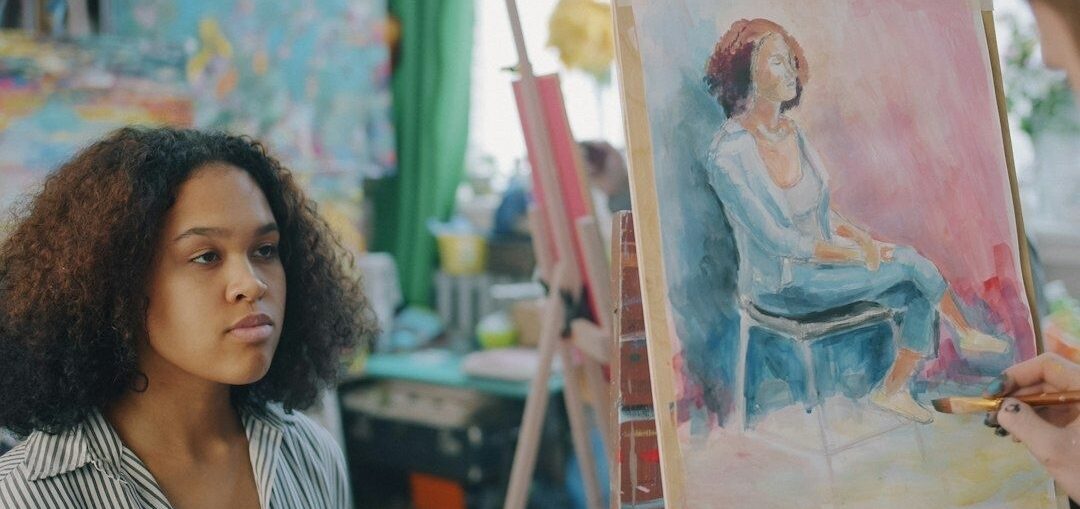
Rethinking the Studio Dynamic Beyond the Passive Model
For centuries, the portrait studio has often been organized around an unequal exchange. The painter looks, interprets, and decides; the sitter waits, performs stillness, and eventually becomes an image controlled by someone else. This arrangement can produce technical brilliance, yet it also carries an extractive logic. A living person is converted into a surface for artistic intention, while their own account of the encounter is treated as secondary or unnecessary.
Observational portraiture is not inherently oppressive, but its conventions can reduce human complexity into a silent aesthetic problem: the angle of a cheek, the fall of light across skin, the symbolic force of clothing. Race, gender, class, disability, and social history may be read into the image without the sitter having any meaningful role in shaping that reading. Contemporary artists are therefore reconsidering visual authorship, not by abandoning observation, but by making observation answerable to relationship. The broader critical history of power, spectatorship, and representation can be explored through discussions of the visual gaze and its politics.
Deconstructing Visual Hierarchy and the Politics of Looking
The gaze is not simply the act of seeing. Sight has a biological basis, but looking is culturally organized. The eye receives light, while the nervous system filters and interprets signals; social experience then gives those perceptions meaning. The distinction matters because a portrait is never only a record of what stood before the artist. It is also a record of expectations about whose body is available for inspection, whose identity is considered legible, and whose interiority is granted authority.
Gendered and colonial histories have made some bodies especially vulnerable to being displayed, classified, eroticized, or disciplined. Feminist critiques of the male gaze showed how women could be positioned as objects of visual pleasure, while decolonial practices have exposed the relationship between portraiture, ethnographic collection, and imperial power. Abigail E. Celis describes contemporary Black French and African artistic responses through strategies of “reprisal” and “refusal”: artists may reveal the machinery of a racial-colonial gaze or develop different, plural ways of seeing. This work does not propose one universally correct replacement gaze. It asks artists to recognize that every visual framework has consequences.
A useful distinction between eye and gaze is developed in the University of Chicago”s eye and gaze resource. For painters, this distinction turns theory into a studio question: what is being seen, and who has the power to determine what that seeing means?
| Extractive convention | Participatory alternative |
|---|---|
| The painter controls pose, lighting, duration, and interpretation. | The sitter helps shape pose, lighting, duration, and interpretive direction. |
| The sitter is expected to remain silent and available. | The sitter is invited to speak, question, revise, and withdraw. |
| The image is treated as the artist”s sole authorship. | Authorship is understood as shared, negotiated, and relational. |
| Personal details become symbolic material without consultation. | Symbols and contextual details are selected with the sitter”s knowledge and consent. |
| Exhibition decisions prioritize institutional or market value. | Display, interpretation, and documentation account for the sitter”s interests and risks. |
Participatory portraiture does not eliminate interpretation. The painter still makes choices about cropping, color, rhythm, surface, and emphasis. The ethical shift lies in making those choices discussable rather than presenting them as neutral acts of artistic authority. The sitter is not asked to approve every brushstroke as though painting were a committee exercise. Instead, the sitter gains access to the representational process and can challenge meanings that would otherwise be imposed without recourse.
Participatory Studio Methods for Shared Authorship
The first practical change is procedural. Replace the silent appointment with a structured exchange in which the sitter understands the project, its intended audience, the likely uses of the image, and the limits of their participation. Early conversation need not become an interrogation. It can begin with questions about comfort, self-presentation, privacy, and what the sitter does not want represented. When appropriate, oral exchanges can be recorded, but recording should be separately consented to and never treated as an automatic extension of the portrait session.
Staging should also become a site of shared authorship. Invite the sitter to select clothing, objects, textiles, photographs, or talismans that carry personal meaning. A treasured object should not be used merely because it supplies visual interest. Its significance should remain available to the sitter, whether or not it is explained to viewers. Artists working with fabric, recycled material, text, or digital references demonstrate how figurative practice can hold social memory and identity without reducing those subjects to illustrative symbols.
- Begin with a plain-language project description and discuss where the portrait may appear.
- Ask the sitter to propose meaningful clothing, objects, gestures, or spatial settings.
- Offer several pose structures rather than imposing a single authoritative posture.
- Use photographs, written notes, color cards, or small studies as shared discussion tools.
- Schedule at least one review before the final surface is resolved.
- Keep a clear record of permissions, revisions, credit, and withdrawal conditions.
Material practice can make collaboration tangible. A sitter might add a drawn line, choose a ground color, annotate a tonal study, or place a pattern within the composition. These contributions do not need to be literal signatures. Their value is that they interrupt the assumption that the artist alone generates meaning. Iterative review is equally important. Show preliminary drawings and ask what feels accurate, exposed, absent, or overdetermined. The question is not whether the sitter recognizes a photographic likeness. It is whether the emerging image permits the sitter to remain complex.
Curatorial Frameworks That Honor Sitter Agency in the Gallery
A collaborative portrait can lose its ethical force if the gallery restores the old hierarchy. The wall label may speak only in the artist”s voice, the portrait may be positioned as evidence of institutional benevolence, and the sitter”s biography may be compressed into a marketable caption. Curators can counter this by treating first-person testimony as part of the work”s interpretive structure. A short statement from the participant, approved in advance, can clarify intention without turning the sitter into a source of emotional content for the institution.
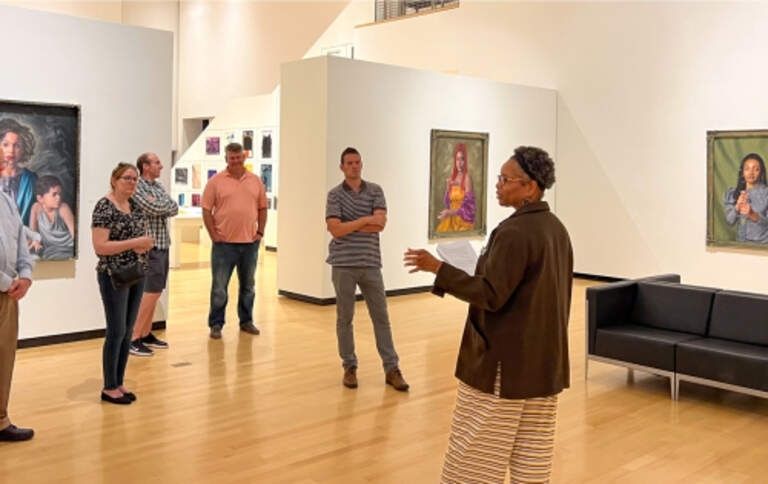
Projects such as community quilt initiatives offer a useful precedent for distributed authorship. In the Lincolnwood and Evanston library collaboration associated with Cozbi A. Cabrera, participants transformed memories into quilt squares, while organizers made privacy decisions about which personal stories were shared. The lesson for portrait exhibitions is practical: participation must include decisions about documentation, not merely production. Similarly, exhibitions addressing colonial history, surveillance, mythology, and ecological extraction show how visuality can be framed as a network of power rather than a private encounter between artist and object.
- Define the sitter as an ethical stakeholder in the exhibition agreement, not merely a model.
- Specify image rights, credit, reproduction, press use, educational use, and withdrawal procedures.
- Invite the sitter to approve biographical language and first-person testimony.
- Assess whether the room layout isolates, monumentalizes, or commodifies vulnerable narratives.
- Provide context through programming that does not require the sitter to perform personal disclosure publicly.
Spatial decisions are also interpretive decisions. A portrait depicting trauma or marginalization should not be placed in a corridor where visitors consume it quickly as evidence of suffering. Seating, pacing, lighting, and proximity to other works can create room for reflection rather than spectacle. Curators should also resist presenting collaboration as automatically virtuous. As debates around socially engaged art have emphasized, participation can become formulaic, exploitative, or institutionally convenient if the artist receives recognition while the community supplies labor and vulnerability. Ethical assessment must therefore include the quality of the relationship, the distribution of benefits, and the final work”s formal integrity.
A Four-Phase Framework for Collaborative Figurative Practice
Phase 1 establishes relational safety. Begin with a non-recorded conversation unless the sitter specifically agrees otherwise. Explain the artistic intention, the anticipated timeline, the possible audiences, and the decisions that remain open. State clearly that consent is ongoing. A sitter should be able to pause a session, decline a question, revise a contextual statement, or reconsider public display without being treated as difficult. This initial phase is not administrative overhead. It establishes the conditions under which visual risk can be shared rather than extracted.
Phase 2 builds the composition together. Test spatial arrangements with quick diagrams, phone photographs, or movable objects before beginning the finished work. Discuss whether the sitter wants direct eye contact, averted attention, physical tension, ease, concealment, or movement. Lighting can likewise be negotiated. Harsh illumination, deep shadow, reflective fabric, or unusual cropping each communicate something about visibility and control. Pose architecture should be understood as a language, not a neutral arrangement of limbs.
- Draw several compositional possibilities and invite the sitter to identify what feels open, false, dignified, or exposed.
- Compare lighting options, including their emotional and symbolic effects.
- Record agreed decisions in a brief shared studio note so revisions remain visible.
Phase 3 introduces review before resolution. Present gesture studies, tonal value sketches, color tests, and partial passages while change is still possible. Ask focused questions rather than seeking a vague reaction. Does the expression feel imposed? Has a personal object become too symbolic? Does the crop make the body appear vulnerable, powerful, defensive, or anonymous? The sitter”s response is not a substitute for the painter”s judgment, but it is essential evidence about the image”s social and emotional effects.
Phase 4 extends authorship into language and public life. Titles, artist statements, catalogue entries, captions, and press materials influence how a portrait is read. Co-authoring these materials can prevent the finished image from being detached from the person who helped shape it. The sitter may prefer a title that names a place, gesture, or private reference, or may prefer no explanatory text at all. Public documentation should also recognize the participant”s contribution and specify how future reproductions will be handled.
Transforming the Canvas into an Encounter of Equals
Collaborative portraiture understands the image as a living relational contract rather than a finished object of capture. The painting remains an authored work, but authorship is no longer confused with unilateral possession. Observation becomes a reciprocal practice in which the painter attends not only to appearance but also to the sitter”s self-knowledge, boundaries, and capacity to contest interpretation.
Genuine veto power can change both ethics and aesthetics. It may prevent a striking but harmful detail from being used, redirect a composition away from cliché, or reveal a visual possibility the painter could not have reached alone. Before beginning the next portrait, set aside the charcoal sketch for the opening portion of the session. Start instead with a conversation about what the sitter wants to make visible, what should remain protected, and which decisions should belong to both participants. That pause is not a delay before the art begins. It is the first mark of a different kind of portrait.