
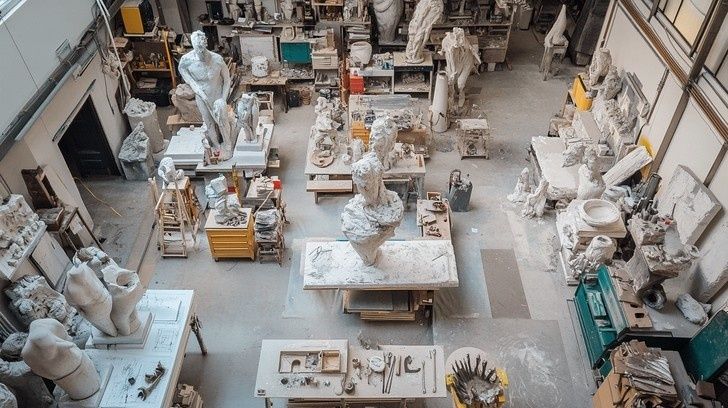
The Deliberate Allure of What Remains Incomplete
Non finito is not the same as an abandoned work. An abandoned work may record fatigue, interruption, changed circumstances, or a decision to withdraw. Non finito, by contrast, makes incompletion active. It allows the raw block, exposed ground, visible underpainting, provisional contour, or unresolved edge to remain materially present because that remainder carries meaning. The work does not merely fail to arrive at completion; it stages the distance between intention and realization.
That distinction matters in a culture increasingly organized around finished, photographed, priced, and rapidly circulated objects. The contemporary art market often rewards visual closure: a work should appear resolved at first encounter, fit a recognizable category, and support a confident appraisal. Non finito interrupts that expectation. Its roughness slows consumption and asks what value might exist before an object becomes fully legible as a commodity. For a concise account of the term”s classical and Renaissance histories, this historical overview of non finito offers a useful starting point. The deeper question, however, is not simply why a work looks unfinished, but what continued uncertainty permits the viewer, the material, and the artist to do.
Historical Foundations from Antiquity to Renaissance Rebels
The philosophical background of non finito reaches toward the Platonic distinction between earthly things and ideal forms. In that framework, no material object can perfectly resemble its transcendent counterpart. Every physical image is partial, situated, and vulnerable to alteration. Leaving a work visibly incomplete can therefore be understood as more than a technical limitation. It can acknowledge the gap between concept and matter, between the imagined form and the resistant substance through which that form must pass.
Roman artistic language contains a related sensitivity to process. The verb faciebat, meaning “was making” or “made,” could identify an artist while retaining the sense of an action in progress. The inscription did not necessarily present the object as a sealed endpoint. Instead, it emphasized becoming, as though the work remained connected to the labor that produced it. This is an important counterpoint to the modern assumption that authorship is best confirmed by a completed, polished result. In this older formulation, the artist”s name could remain attached to an event of making rather than only to a finished possession.
During the Renaissance, Donatello and Michelangelo gave this logic forceful physical form. In non finito sculpture, the figure may seem to emerge from the quarry block while still being held by it. The stone becomes an active participant in the image, not merely a passive support. Michelangelo”s partially released bodies produce a charged encounter between anatomical possibility and geological resistance. The viewer is made to sense both the imagined figure and the labor required to separate it from material. Donatello”s experiments likewise transformed incompletion into a field of tension, where surface, depth, and emergence remain unsettled.

- The unfinished surface can preserve the history of resistance between hand, tool, and material.
- The partially revealed figure can make potential more visible than completion would.
- The visible block or ground can prevent the image from pretending to be independent of its making.
A Subversive Threat to the Turnkey Art Market
The turnkey art market depends on legibility. Galleries, fairs, auction rooms, and digital platforms need works that can be quickly identified, compared, documented, installed, and transferred. This does not mean every commercial artwork is superficial, nor that a polished work cannot be conceptually rigorous. It does mean that systems of circulation tend to favor objects whose condition appears stable and whose meaning can be summarized without prolonged negotiation.
Non finito creates friction at precisely those points. Raw edges complicate decisions about where the artwork begins and ends. Underpainting reveals provisional choices that a conventional presentation might conceal. A visible correction, fragment, or incompletely modeled passage makes it harder to treat the work as a neutral container of value. The surface insists that value is being produced through duration, revision, and uncertainty. It does not offer the viewer a single instant of consumption, but an encounter that unfolds through inspection.
The distinction between a polished commodity and an open procedural work can be clarified in practical terms.
| Polished market object | Open-ended procedural work |
|---|---|
| Emphasizes visual closure and stable presentation | Exposes duration, revision, and material contingency |
| Supports rapid recognition and comparison | Requires sustained looking and interpretive patience |
| Conceals or integrates most traces of construction | Allows construction marks to remain structurally important |
| Encourages ownership of a resolved object | Frames ownership as participation in an ongoing question |
This resistance can also be political. Artistic practices that refuse neat resolution may align with broader forms of dissent, especially when institutions prefer consensus, branding, and risk management. The history discussed in Artists & Protest: an Incomplete History shows how artists use unfinished, contradictory, or disruptive forms to challenge dominant narratives, while also facing material pressures from funders, employers, and exhibition systems. Non finito does not automatically make a work activist, but its refusal of seamless resolution can protect space for contradiction and disagreement. It reminds institutions that cultural meaning cannot always be delivered as a finished product.
The Viewer as Active Collaborator in Meaning Making
Non finito changes the viewer”s task from recognition to construction. Perception is never only optical reception. It involves memory, expectation, imagination, and emotional response. When a surface withholds a definitive image, the mind begins to test possibilities. A shadow may become a body, a scraped line may suggest a contour, and an empty area may register as either absence or latent form. The viewer does not simply receive a completed statement; the viewer participates in determining what kind of statement is possible.
This process has a useful parallel in Cubist approaches to seeing. Picasso, Georges Braque, and Juan Gris challenged the assumption that an image must represent a single stable viewpoint. Multiple perspectives, temporal shifts, and fractured planes could coexist within one field. The same kind of active navigation occurs when a viewer moves across an unresolved sculpture or painting. The eye must shift between what is shown and what is withheld, between the visible gesture and the imagined continuation. The beholder becomes an intellectual participant, completing neither the object nor the artist”s intention, but completing the conditions of encounter.
Studio Principles for Cultivating Generative Restraint
The crucial studio problem is distinguishing generative suspension from negligence. Not every rough passage is meaningful, and not every unfinished object should be defended as non finito. A work becomes critically open when its incompletion has compositional, conceptual, or material consequences. The remaining rawness must do something. It may expose a conflict between image and support, preserve the chronology of making, interrupt an expected illusion, or create a space in which the viewer”s perception remains active.
Assessment requires patience and a willingness to separate discomfort from insight. A passage may feel unresolved simply because it is weak, underdeveloped, or insufficiently considered. Another may feel unresolved because its uncertainty is the work”s central structure. The distinction becomes clearer when the artist examines whether further intervention would deepen the inquiry or merely satisfy anxiety about appearance. The following sequence can help guide that decision.
- Describe before judging. Record exactly what remains visible: a raw edge, a blocked-in form, an exposed support, an abrupt transition, or an area without detail. Avoid immediately calling it successful or unsuccessful.
- Identify the function of the remainder. Ask what the unfinished passage contributes to rhythm, scale, tension, meaning, or material awareness. If it contributes nothing beyond postponement, further work may be necessary.
- Test the work at different distances. Examine it close up, from across the studio, and through documentation. A generative interruption should maintain some force across changing conditions of attention.
- Make a reversible intervention. Use a temporary drawing, removable layer, model, photograph, or digital simulation to imagine the work more resolved. Compare the proposed completion with the existing state rather than assuming completion is automatically better.
- Protect the evidence of making. If the work is finished in its current state, stabilize and present its process marks deliberately. Lighting, framing, plinth height, and wall color should clarify the material rather than disguise it.
Material honesty does not require careless presentation. A rough sculpture may need a precise plinth. A painting with exposed ground may need controlled lighting so that the ground reads as an intentional field rather than damage. Conservation concerns should also be addressed directly, especially when unstable materials, friable surfaces, or temporary structures are involved. The aim is not to freeze the work into false permanence, but to establish conditions in which its openness can be encountered responsibly.
Keep the Work Open to Time and Dialogue
Non finito remains urgent because it restores time to an art world that often rewards instant recognition. It keeps the work connected to decisions, hesitations, resistance, and unrealized possibilities. That connection can be philosophically modest and materially concrete: a chisel mark, a scraped ground, or an absent final layer can insist that the artwork is not separate from the history of its becoming.
For artists, the practical challenge is to let process supersede finality without using incompletion as an alibi. For collectors and curators, it is to value works that demand sustained attention rather than immediate confirmation. Before asking whether a work looks finished, ask what its visible incompletion makes possible. If the answer includes a richer relation between material, maker, and viewer, then the unresolved state is not a deficit. It is the work”s living friction, and perhaps its most durable form of resistance.