
The Tyranny of the Blank Slate
The blank canvas is often treated as the purest symbol of artistic freedom. In practice, it can become an arena of decision fatigue. Every pigment appears available, every scale seems possible, and every compositional direction remains open. For a painter already carrying several unresolved intentions, this abundance does not necessarily produce confidence. It can produce hesitation, repeated revisions, and a defensive kind of looking in which each mark is judged before it has had time to become meaningful.
Creative friction offers a more productive arrangement. It is not an obstacle placed between the artist and expression, but an intentional navigational boundary that reduces irrelevant choices while sharpening consequential ones. A restricted palette, a compressed working area, or a timed session can create the conditions for faster perception and more decisive action. The framework developed here moves across three fields of practice: spatial constraints that make the studio physically active, chromatic constraints that organize visual relationships, and temporal constraints that protect intuition from premature critique. Artists seeking a more structured limited palette painting practice will find that each boundary can function as a tool for attention rather than a denial of freedom.
Chromatic Restraint as a Catalyst for Harmony
Color generates an exceptional number of micro-decisions. A painter must assess hue, value, temperature, saturation, opacity, and the relationship between each mixture and the surrounding field. When every tube is available, these decisions can become disconnected from one another. A reduced palette changes the problem. Instead of asking which of many colors might be appropriate, the painter asks what a small set of pigments can do, where their limits lie, and how relationships can be adjusted through proportion, value, and temperature.
This reduction deepens tonal understanding because color can no longer conceal structural weakness. A three-pigment setup, perhaps a warm red, a yellow, and a blue supported by white, requires careful observation of mixtures rather than reliance on pre-made hues. The result is often a more unified visual language. Artists working with the Zorn palette, traditionally associated with cadmium red, yellow ochre, ivory black, and titanium white, discover that black can participate in chromatic mixing rather than functioning merely as a neutral dark. Felicia Forte”s account of the palette describes how black and yellow can produce convincing greens when white is used sparingly. The limitation becomes a lesson in proportion and optical temperature.
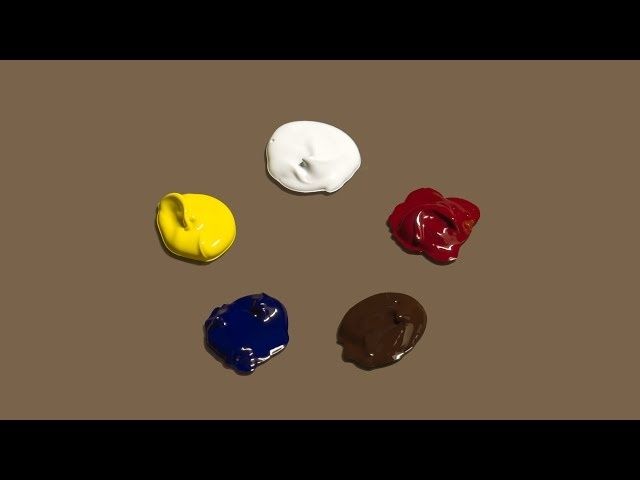
Limited color does not mean limited visual interest. Texture, edge quality, drawing, brush direction, impasto, value contrast, and shifts in saturation can carry the complexity that a larger range of pigments might otherwise provide. A warm palette may excel at oranges and earth colors while producing weaker violets or saturated greens. That limitation is not a technical failure; it is a compositional fact that should influence the subject selected and the expectations brought to the painting. The following comparison clarifies how different kinds of chromatic restraint alter studio behavior.
| Chromatic constraint | Primary lesson | Practical studio impact |
|---|---|---|
| Zorn palette | Value, temperature, and controlled neutrals | Encourages economical mixing and strong value organization |
| Three-pigment setup | Mixture range and pigment relationships | Reduces selection fatigue and reveals the character of each pigment |
| Monochrome or black and white | Structure before hue | Exposes drawing, value, edges, and compositional imbalance |
| Complementary pair | Harmony through opposition | Produces related neutrals while maintaining chromatic tension |
The most useful constraint is targeted rather than ceremonial. If paintings feel visually noisy, limit the palette. If colors appear technically accurate but emotionally disconnected, retain only pigments that belong to the subject”s dominant temperature. If the work is overworked, remove small brushes and require broader marks. Guidance from Realism Today”s discussion of the Zorn palette makes the larger principle clear: rules are most effective when the reason behind them is understood. Once a limitation reliably produces stronger decisions, it can be loosened. The aim is not obedience to a formula, but increased control over perception.
Architecting the Physical Field
The studio is not a neutral container. Its walls, pathways, light, storage systems, and available working distance shape what can be seen and how the body can respond. A very large canvas asks for movement across space, while a small panel concentrates attention into the wrist, hand, and eye. A compressed studio can therefore become more than an inconvenience. It can act as a compositional participant, forcing scale, viewpoint, and gesture into conscious negotiation.
This principle is visible in practices that deliberately extend painting into architectural or viewer space. Thomas Schneider”s sculptural paintings, as described by Fountain House Gallery”s artist feature, incorporate floor space as part of the work”s spatial experience. The boundary between object and environment becomes active rather than merely decorative. Even without constructing an installation, painters can use similar thinking by allowing the studio”s physical conditions to inform the work.
- Use a cart or compact rolling table so that materials must be selected before a session begins.
- Position the support where changing viewpoint becomes necessary, encouraging observation from standing, seated, and oblique positions.
- Limit the working footprint with tape on the floor, especially when gesture has become unfocused.
- Store reserve materials out of immediate reach so that expansion of the process requires a conscious decision.
- Turn an architectural obstruction, such as a narrow passage or low ceiling, into a prompt for altered scale or compressed mark-making.
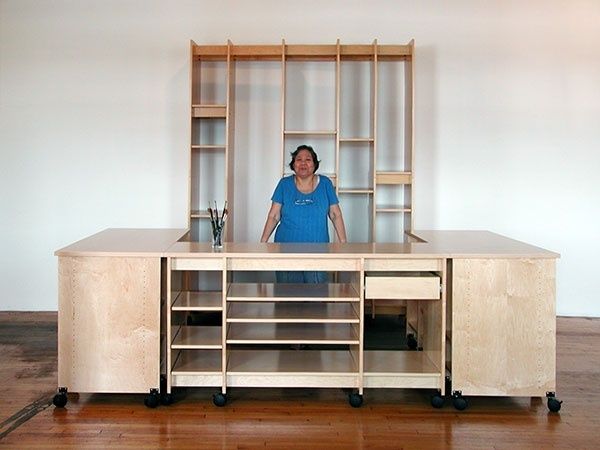
A cart-based setup is particularly useful in unconventional spaces because it makes process portable and visible. The cart becomes a mobile score for the studio: a defined arrangement of tools, mediums, rags, supports, and references. Classroom routines built around carts and clear spatial expectations demonstrate how physical organization can reduce transition time and preserve attention, even though the original setting is educational rather than professional. For an artist, the equivalent is not rigid housekeeping for its own sake. It is the construction of an environment in which every movement supports the work”s central question.
Temporal Scaffolding and the Power of Studio Rituals
Time limits often appear to threaten artistic depth. A short session can seem incompatible with subtle observation, layered surfaces, or sustained revision. Yet an open-ended studio day can produce its own pressure, particularly when the painter continually postpones commitment. A time boundary works as a protective container because it makes the session finite. The artist is no longer responsible for resolving the entire work immediately and can instead concentrate on what this particular interval is meant to accomplish.
The first mark benefits especially from ritualization. A repeated sequence, such as preparing the palette, placing the support, setting a timer, and making several broad observations before touching the surface, can signal a transition from evaluation to engagement. Ritual is useful here in a practical rather than mystical sense. It creates an ordered set of actions that reduces negotiation with the self. Timed sprints of five or fifteen minutes can bypass internal critique by making speed part of the assignment. The resulting marks need not survive. Their value may lie in revealing the painting”s directional energy, latent composition, or resistance to a particular gesture.
A focused session can be designed as a sequence of distinct containers rather than one undifferentiated block of labor.
- Define one operational question, such as whether the composition holds together in three values or whether the surface needs broader directional movement.
- Prepare only the materials permitted by the session, including the selected pigments, tools, support, and cleaning materials.
- Set a short opening sprint of five to ten minutes and make the initial structure without correcting minor inaccuracies.
- Pause for two minutes of observation at a physical distance, recording only visible facts rather than interpretations.
- Work through a second timed interval devoted to one variable, such as edges, temperature, or mass distribution.
- End before exhaustion, photograph the state, and write a brief note identifying what the constraint revealed.
The final step matters because a ritual should include integration, not only production. A photograph taken under consistent lighting allows comparisons across sessions, while a short written record identifies whether the time limit produced urgency, clarity, superficiality, or avoidance. The broader psychology of ritual emphasizes preparation, symbolic objects, location, timing, and later integration. In studio practice, these elements can be modest: a particular cloth, a recurring piece of music, a marked start time, or a deliberate act of covering the palette. Their function is to establish a threshold between habitual indecision and purposeful making.
Iterative Evaluation and Shifting the Parameters
No constraint should become a permanent identity. A palette that once corrected excessive color may eventually produce predictable neutrals. A strict format that initially clarified composition may later encourage repetition without inquiry. The task is to recognize when resistance has served its purpose. Evidence can be found in the work itself: decisions become faster, recurring problems become legible, and the same formal solution begins to appear regardless of subject or intention.
Evaluation should therefore be curatorial as well as technical. Review a group of works together rather than judging only the latest canvas. Look for repeated temperature patterns, habitual scales, identical edge treatments, or a narrowing of subject matter that was not consciously chosen. Then alter one parameter at a time. Expand a three-color palette to five pigments, change the support”s proportions, reverse the studio viewpoint, or replace a ninety-minute session with several brief studies. This creates a productive dialectic between rigidity and breakthrough. Creative practice under constraint, as explored in work on creativity under pressure, is strongest when constraints remain responsive to context rather than becoming mechanical technologies.
A long-term body of work benefits from alternating phases. Begin with a stable rule long enough for its effects to become visible, then introduce a controlled disturbance. The disturbance should be specific enough to evaluate. Changing everything at once produces novelty but little knowledge. Changing one condition reveals causality: perhaps the larger brush improved structural unity, while the additional pigments merely increased indecision. In this way, constraints become instruments of research. They generate a record of what the artist can perceive, what the hand tends to repeat, and where expressive breakthrough is most likely to occur.
Embracing Boundaries to Free the Work
Spatial, chromatic, and temporal friction are most powerful when treated as a coordinated daily practice. A compact cart can define the physical field, a reduced palette can unify the image, and a timed ritual can prevent hesitation from governing the first half-hour. Together, these boundaries shift attention away from managing possibility and toward studying relationships: mass against void, warm against cool, pause against acceleration, and intention against material resistance.
The paradox is practical rather than abstract. Discipline does not eliminate freedom; it concentrates it. Tight limits give the painter fewer places to hide from a decision, but they also make decisions more legible and more consequential. For the next studio session, select one operational friction only. Use three pigments, work within a taped floor boundary, or set a twenty-minute first pass. Do not ask whether the rule is expressive enough. Ask what it makes visible. The answer will provide the next parameter, and the next parameter will help the work move.