
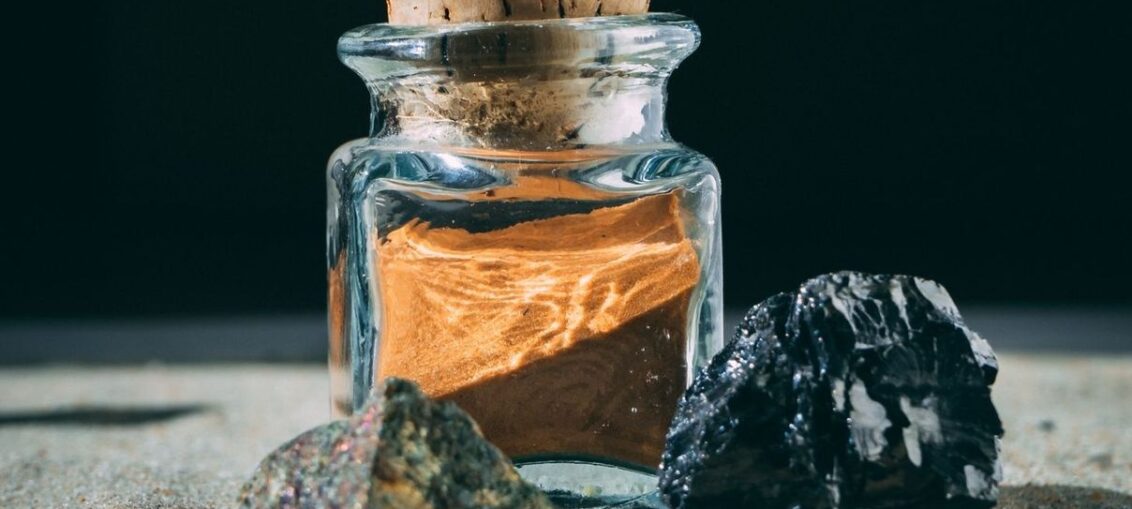
Rediscovering Art Through the Earth Beneath Our Feet
Much of the contemporary studio palette arrives as a finished commodity. A tube of paint, a pan of watercolor, or a bag of dry pigment may carry a familiar color name, yet conceal the geological extraction, industrial processing, synthetic chemistry, packaging, and transport behind it. This distance can make material choice appear neutral when it is anything but. Every pigment has an origin, and every origin carries consequences for land, labor, energy, waste, and cultural meaning.
Bioregional pigment foraging offers a different relationship to color. It is not simply a nostalgic return to an older craft, nor an invitation to remove whatever looks attractive from a landscape. It is an ecological dialogue based on attention, permission, restraint, and repeated observation. Soil, stone, silt, soot, leaves, bark, flowers, and berries become materials to be studied within their habitats, not merely harvested as supplies. A local palette can therefore record season, geology, weather, and human alteration with unusual precision.
The tactile and chemical range is broad. Mineral ochres can be earthy, opaque, and comparatively stable, while botanical lakes and plant inks may be luminous, transparent, and fugitive. A raw stone may reveal an unexpected red only after grinding, or a grey clay may produce a warm buff once dried. Cultivating these materials joins site ethics with sediment processing and pigment stability. The studio becomes a place where environmental responsibility is not an added statement but part of the color’s physical construction.
The Philosophy of Site-Responsive Color and Circular Practice
Color changes meaning when it is tied to a defined geography. A red gathered from a local iron-rich bank is not interchangeable, conceptually or materially, with a commercially manufactured red of similar appearance. Its hue is connected to a particular sediment, its texture to a particular process of grinding and washing, and its presence in an artwork to a specific place. This does not mean that locally gathered color automatically produces authentic art. Rather, it gives the artist a more accountable set of questions: Where did this material come from? Who has a relationship with the land? What may be removed, and what must remain?
Circular practice extends those questions beyond collection. It asks how materials are selected, used, maintained, reused, and returned to circulation. Artists can save wash water for settling, retain coarse residues for texture, repurpose failed paint tests, and design tools and containers for long service. The Centre for Circular Materials at Arts University Plymouth exemplifies this approach by connecting creative research, teaching, fabrication, and regional resources in South West England. Its work demonstrates that local matter can be investigated as a viable medium while its wider ecological and social effects remain visible.
This perspective also shifts the role of research. A studio need not treat local materials as raw ingredients awaiting artistic improvement. Geological knowledge, community histories, land-use records, ecological monitoring, and traditional practices can all shape the work before a brush touches a surface. Organizations such as Material Cultures similarly place bioregional and regenerative thinking at the center of design, asking how material systems might operate within ecological limits. For the visual artist or ceramicist, this means that a pigment archive can become both a color resource and a record of regional change.
Ethical Foraging Principles and Regional Ecology
Responsible gathering begins with recognizing that access is not the same as permission. A stone exposed beside a path may lie within protected land, a culturally significant site, private property, or a habitat where disturbance matters. Botanical materials require equal care. Removing flowers, bark, roots, or seed heads can affect pollinators, regeneration, and food webs, particularly when several makers collect from the same area. Research local regulations and land permissions before collecting, and avoid archaeological, sacred, protected, and unstable sites.
Geological cutaways, eroded streambanks, existing spoil piles, and construction disturbances may offer safer opportunities than intact ground, but they still require judgment. Never enter an active worksite without explicit authorization, and do not undermine banks or disturb waterways. Record the location, date, weather, material description, and amount collected. A small sample taken from an already exposed fragment is usually more defensible than digging into a living landscape. For botanical color, prefer fallen material where appropriate, gather only a small fraction, and leave enough for the plant and the organisms that depend on it.
- Obtain permission and check local conservation, land-access, and collecting rules.
- Do not collect from protected, sacred, archaeological, unstable, or ecologically sensitive sites.
- Take the smallest viable sample and never remove an entire plant or visibly deplete a population.
- Keep botanical, soil, and mineral samples clearly labeled with place and date.
- Wear suitable protection, avoid inhaling dust, and assume unknown minerals may contain hazardous components.
- Separate field ethics from artistic ambition: an unusual color is never a reason to damage a habitat.
From Raw Strata to Fine Pigment Through Levigation
Processing begins with patience and dedicated equipment. Raw rocks, shale, clay, and ochre often contain coarse grit, organic matter, salts, or fragments that can scratch a surface and compromise a finished medium. Use tools reserved for studio materials rather than food preparation. A mortar and pestle can break down softer material, while a hammer and robust surface may be needed for harder stone. Work outdoors or in a controlled area, use eye protection and a properly fitted respirator, and avoid creating airborne dust. The apparent color of a rock is only a first impression; grinding can expose a different hue and reveal variations within the sample.
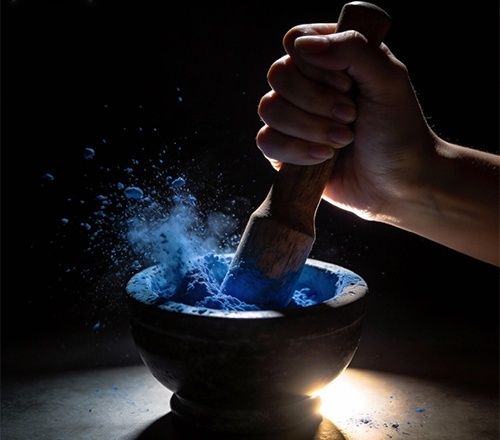
Dry grinding and repeated sieving provide a straightforward starting point, but levigation offers finer control. The method relies on differential settling. When powdered material is suspended in water, larger and denser particles settle more quickly, while very fine particles remain suspended for longer. This behavior can be understood through Stokes’ Law, which relates settling velocity to particle size, density, and fluid viscosity. The process is not a laboratory-grade separation unless carefully controlled, but it allows coarse grit to be removed and a softer, more homogeneous pigment fraction to be collected.
- Break the cleaned material into manageable pieces, then grind it gradually until it resembles a fine, even powder.
- Pass the powder through a fine sieve and reserve the coarse fraction for further grinding or textured applications.
- Place the fine material in a container with water and agitate it thoroughly so the particles become suspended.
- Allow heavier grit to settle briefly, then decant the still-clouded suspension into a clean container.
- Repeat the suspension and decanting stages until the desired fineness is reached, keeping separate fractions labeled by source and process.
- Let the finest material settle completely, pour away excess water, and dry the sediment slowly on a nonreactive surface.
Drying changes the handling of the pigment again. A compact sediment may need to be gently crushed and passed through a sieve before it can be mulled. Some clays retain water strongly and may require extended drying, while certain mineral powders become electrostatically mobile and difficult to contain. Keep samples in airtight, labeled jars, but allow damp botanical material to dry thoroughly before storage to prevent mold. A useful archive records not only the final color but also particle size, opacity, staining strength, pH observations when relevant, and behavior in different binders.
Binding Soils and Flora into Lasting Studio Mediums
Pigment becomes paint only when it is joined to a binder that can carry, adhere, and protect the particles. Mulling is a physical process as much as a technical one. A small amount of binder is worked into pigment on a glass slab with a muller, breaking aggregates and coating particles evenly. The aim is not simply to make the mixture smooth. Excessive grinding can alter some delicate materials, while insufficient grinding leaves a weak, gritty paint. Begin with small tests, because local earths vary greatly in absorbency and binder demand.
Cold-pressed linseed oil can produce a dense, durable oil paint, although it may yellow over time and can remain wet for a considerable period. Gum arabic is suitable for watercolor and related water-based applications, often combined with humectants such as honey or glycerine to control rewetting and flexibility. Egg tempera dries rapidly to a relatively matte, precise film and can clarify the character of mineral particles, but it requires fresh preparation and careful handling. Botanical colors may work beautifully in water-based media yet fade under light, alkalinity, or repeated exposure to moisture. That instability can be treated as a limitation, or deliberately incorporated as part of the work’s temporal meaning.
| Binder | Typical working character | Useful considerations |
|---|---|---|
| Linseed oil | Rich, saturated, relatively durable film | Good for many earth pigments; may yellow and requires controlled drying conditions |
| Gum arabic | Transparent to translucent water-based paint | Suitable for watercolor; rewetting, flexibility, and preservation require testing |
| Egg tempera | Fast-drying, matte, finely controlled surface | Works well with finely processed pigments; prepare in small quantities and use promptly |
Binder choice also carries cultural responsibility. Natural ochres are not merely convenient earth colors in every context. Across many Indigenous traditions, earth pigments are connected to ceremony, ancestry, law, and country. Artists working outside those traditions should avoid treating culturally specific practices as aesthetic effects available for extraction. The virtual exhibition The Inside World exhibition at Frost Art FIU presented contemporary Aboriginal Australian memorial poles in which material, ancestral narrative, and landscape are inseparable. Such work encourages close looking, but it also asks viewers to distinguish appreciation from appropriation and local experimentation from inherited cultural authority.
Grounding Your Creative Life in Living Geologies
Working with home soil changes the artist’s relationship to color at several levels. Intellectually, it makes provenance and consequence part of composition. Environmentally, it encourages modest extraction, reuse, and attention to the conditions that produce materials. Tactilely, it slows the process down: a color must be searched for, cleaned, ground, suspended, dried, and tested before it can become an image. Even failure becomes informative. A wash may separate, an ochre may lose saturation in oil, or a plant ink may fade into a paler record of the season that produced it.
The studio can therefore be understood as a node within local natural systems rather than a consumer of standardized supplies. Survey the terrain around you with informed curiosity. Learn to distinguish soil from mineral seam, fallen botanical matter from living growth, and accessible material from material that should remain undisturbed. Keep records, test conservatively, consult local knowledge, and let the limits of a place shape the work. A bioregional palette does not promise complete independence from industry, but it can make artistic dependence more transparent, more careful, and more meaningfully connected to the living ground.